
Local Leaders Are Saying NO to Flock
Get the Flock Out of MA!
Email Your Municipal Leaders: Unregulated license plate readers threaten our privacy and safety.
License plate readers (LPRs) are a common police surveillance technology that threaten our privacy and safety.
With LPRs, law enforcement can track drivers' real-time and historical location information. In other words, they can see exactly where you’ve been and where you’re going. And they don’t even need a warrant.
Massachusetts needs statewide driver privacy protections NOW.
Take a moment to email your municipal leaders and ask them if your local police department is using Flock's LPR technology or LPR technology through a different provider, and if so, whether they are sharing LPR data with agencies outside your community.
Last updated on October 08, 2026
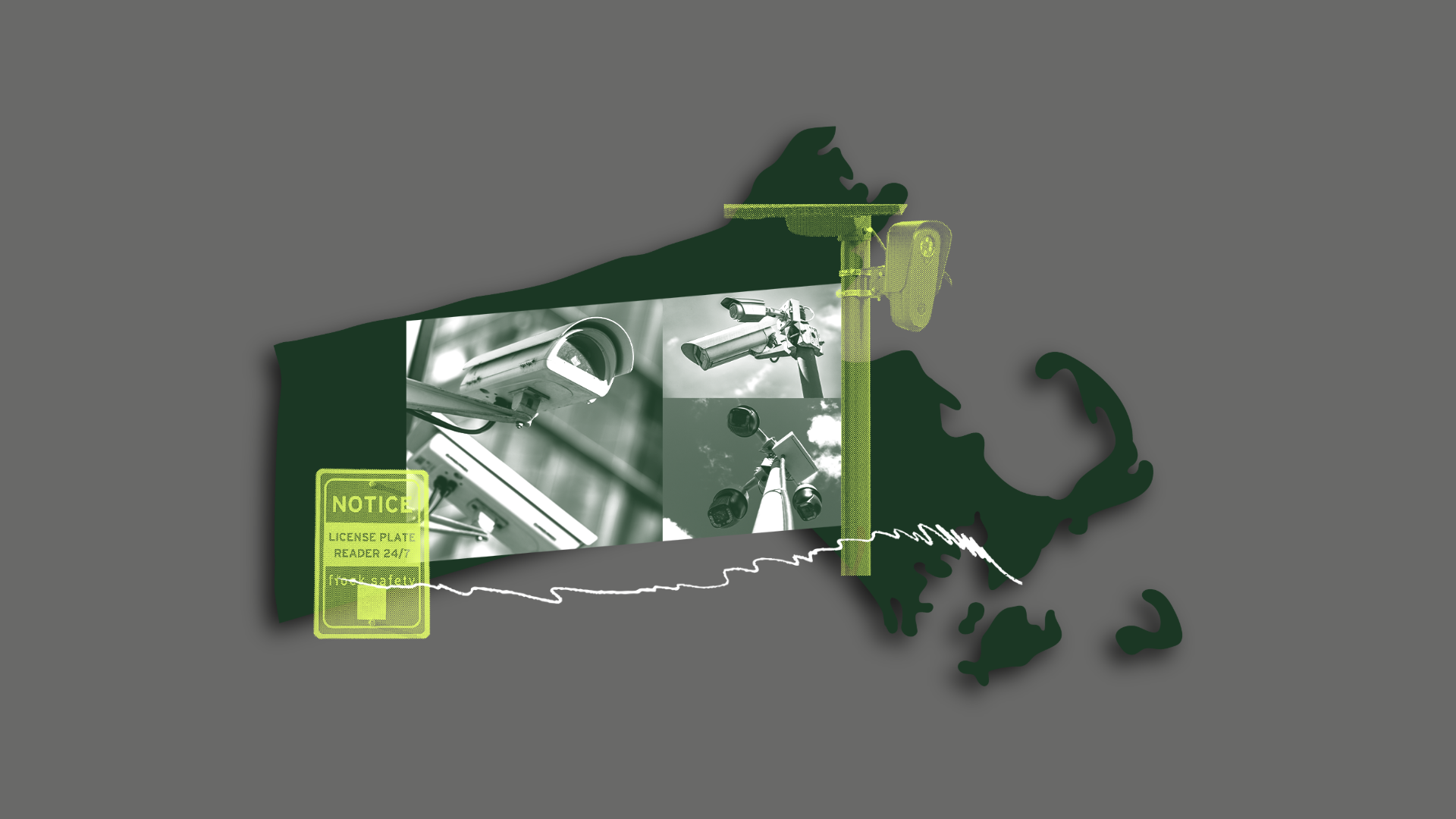
Over 40 municipalities in Massachusetts have rejected AI-powered mass surveillance cameras. Learn how to join them.
Since October 2025, the ACLU of Massachusetts has been raising awareness about police use of Flock Safety's automatic license plate reader technology. License plate readers (LPRs) enable police and private companies to track anybody who drives past an LPR camera, regardless of whether the driver is suspected of wrongdoing.
Flock is by no means the only company offering LPR services to government agencies, nor is it the only company whose products raise significant civil rights or civil liberties issues. But Flock has come under especially intense criticism, in part because of its business model, which has incentivized police departments to engage in widespread data sharing. This model enables law enforcement agencies nationwide to track Massachusetts drivers in the Flock database without a warrant or even reasonable suspicion of wrongdoing. The company has also been credibly accused of violating basic cybersecurity standards, misleading local officials, and shrugging off basic democratic oversight by failing to remove or deactivate cameras after local governments have directed police to stop using Flock LPRs.
Flock's dragnet surveillance technology and nationwide data sharing model put our civil liberties and privacy at risk. And Massachusetts residents across the state are fighting back.
Outrage over law enforcement using Flock to surveil immigrants, stalk former romantic partners, and keep tabs on anyone who drives past a Flock camera has led residents and grassroots organizations across the Commonwealth to organize to stop this Big Brother-style surveillance in their communities.
The Massachusetts communities listed below have all said Get the Flock Out!
If your community isn’t included, consider taking action by emailing your local leaders. For more information on how to fight LPR surveillance, check out our Community Advocacy Toolkit and Local Conversation Guide.
Please direct any questions to Gideon Epstein at gepstein@aclum.org.
Note: This map uses ZIP codes, not municipal boundaries. As a result, the highlighting is not precise. In particular, Westhampton has not cut ties with Flock but it is nonetheless highlighted on the map because it shares a ZIP code with a municipality that has.
Flock Municipal Wins
These Massachusetts communities have stopped using Flock. The list will be updated periodically.
October
Milton
The Milton Select Board voted to end the town's contract with Flock and remove LPR cameras around town.
Rochester
The Rochester Police Department announced that its Flock cameras will be inactive for 30 days while local leaders consider community members' concerns, particularly regarding privacy, how information is stored and shared, and whether data collected through the Flock system could be sold or otherwise used in inappropriate ways.
September 2026
Norwell
Following discussions with residents and the town's Select Board, Norwell's police department announced that it is discontinuing its use of Flock LPRs.
Westwood
The Westwood Police Department announced that it has temporarily suspended its use of Flock LPRs. The announcement stated that the police chief would be checking the system and audit logs to ensure the cameras remain off and are not being accessed.
North Attleboro
Following a lengthy, well-attended public hearing, the North Attleboro Town Council voted 8-0 to temporarily suspend the town's use of its seven Flock cameras.
Tewksbury
The Tewksbury Police Department announced that it will end its relationship with Flock and stop using the system, citing lack of community support, which the police chief said "weighed heavily in this decision."
Methuen
The City of Methuen will be ending its use of Flock cameras, following local officials' decision to pause the installation of additional Flock cameras. City officials said the cameras currently installed will be covered until they can be removed.
Lowell
The Lowell City Council voted to temporarily suspend the use of Flock surveillance cameras. Councilors voted 6-5 to pause Flock use, pending a thorough review of audits and policies surrounding law enforcement use of the technology.
Nantucket
The Nantucket Select Board voted unanimously to end Nantucket's use of Flock cameras, citing public polling and other communities canceling their contracts as factors in the decision. Police department staff have taken down the cameras.
Wilmington
The Wilmington Police Department announced that it is terminating its contract with Flock, citing community concern over privacy as a driving force in their decision making. The police department will remove existing Flock cameras as soon as possible.
Boylston
Town and police leaders announced that Boylston will immediately suspend its use of Flock LPRs while the town's Flock contract is formally terminated. The Select Board cited issues relating to state procurement law as the reason for termination.
Waltham
Waltham's mayor ordered city employees to cover all Flock cameras used by the Waltham Police Department with black trash bags.
Stoughton
Stoughton's acting police chief announced that all Flock cameras in town will be removed by October 1. In the meantime, town workers will cover Flock cameras with bags.
Barre
According to Barre's police chief, one Flock camera has been deactivated in Barre, and plans to install a second camera have been suspended due to privacy concerns. Barre has also deactivated all officers’ Flock accounts.
Barnstable
The Barnstable Town Council voted 7-3 to end the town's contract with Flock and discontinue use of its automated license plate readers.
Acushnet
The Acushnet Board of Selectmen voted unanimously to discontinue the Acushnet Police Department’s use of Flock license plate readers pending a review for contract termination. Until recently, the police department was using Flock's nationwide data sharing feature.
August 2026
Dartmouth
Dartmouth’s police chief announced that the town will not be renewing its contract with Flock due to privacy and cost concerns.
Ayer
The Ayer Select Board voted unanimously to immediately cancel the town’s contract with Flock.
Abington
Abington's police chief announced that the police department will end its agreement with Flock and will request that the cameras be removed.
Groton
The Town of Groton announced it is terminating its contract with Flock.
Southbridge
The Southbridge Police Department announced it is suspending the use of Flock ALPRs. The department also noted that since the time the Flock cameras were installed, they were not used by Southbridge officers for any investigative or enforcement purpose.
Easton
The Easton Police Department terminated its contract with Flock. Easton’s police chief noted that he had been monitoring public sentiment and the concerns of Easton residents and others across the Commonwealth in the leadup to ending Flock’s deployment.
Bellingham
The Bellingham Police Department's contract with Flock expires in September 2026. The department decided not to renew the contract, citing cost and transparency. Specifically, the Police Department expressed concern that Flock turned on AI-surveillance features the department was not aware of, contradicting statements police leadership had made to members of the public about the technology’s capabilities.
Auburn
The Auburn Police Department announced it severed its relationship with Flock due to a "contractual defect.”
Douglas
The Douglas Police Department announced it will stop using Flock cameras in town, immediately deactivating all the cameras and department accounts.
East Bridgewater
After hearing residents’ concerns about Flock, East Bridgewater's police chief announced the town no longer has plans to roll out Flock LPRs. The town's Flock contract will be terminated, and the one installed Flock camera will be removed.
Grafton
The Grafton Police Department began deactivating all automated license plate readers from Flock just weeks after it signed a contract with the company.
Hopkinton
Hopkinton's Select Board voted to cancel the town's contract with Flock after significant public pushback. Notably, after a legal review of the town's Flock contract, the town concluded the contract violated state procurement law.
Stow
Stow's police department disabled the town's Flock cameras, terminated their Flock contract, and placed an officer on leave after the officer allegedly queried the Flock system for personal reasons.
Wellesley
The town decided to terminate a pilot program early, ending Flock deployment in Wellesley.
Littleton
After the Littleton Select Board voted to temporarily disable the town's Flock LPR use, Flock reactivated most of the cameras without the town's knowledge. Following this breach of trust, Littleton officials ordered that its Flock cameras be taken down.
New Bedford
Police in New Bedford temporarily suspended their use of Flock after significant public opposition and allegations that a New Bedford police officer used Flock license plate readers to stalk her ex-girlfriend.
New Bedford residents speaking out against mass surveillance helped drive this victory.
July 2026
Salem
City officials announced Salem would discontinue its Flock deployment and find alternative license plate readers with stronger protections around local control of data. Northshore Progressives led a coalition of local grassroots organizations and residents to achieve this victory.
Easthampton
Easthampton stopped using Flock cameras after city councilors cut funding for the tech company’s software earlier this year.
June 2026
Framingham
After months of resident opposition and grassroots organizing by Framingham Fights Back and other local organizations, the police department chose not to renew its Flock contract.
Sharon
Sharon's Select Board voted not to renew the town's Flock contract when it expires in September 2026.
March 2026
Attleboro
Attleboro ended its deployment of Flock LPRs, citing cost concerns.
January 2026
Greenfield
The City of Greenfield ended its deployment of Flock LPRs, citing cost concerns.
Natick
Natick's Select Board unanimously voted to end the town's Flock pilot program.
Watertown
After agreeing to install eight Flock cameras, the City of Watertown canceled its Flock contract. Watertown's city manager cited concerns about entrusting a private company like Flock with license plate reader data and raised questions about technology's role in policing.
December 2025
Cambridge
After the Cambridge City Council unanimously voted to pause the city's Flock deployment to vet the technology for data privacy and security concerns, Flock installed two new cameras in Cambridge. Following this breach of trust, Cambridge promptly ended its contract with Flock.
Digital Fourth and Old Dykes Against Billionaire Tech Bros' advocacy was integral to this victory.
September 2025
Boston
After Boston's Flock pilot program ended, the city opted not to continue using Flock. Boston did subsequently pilot LPR cameras supplied by competing tech companies Motorola and Axon, however.
Related Issues
Related Content
- Privacy and Surveillance