
Court Cases
All Cases
119 Court Cases
Sep 15, 2026

League of Women Voters of Massachusetts v. Trump
This case challenges restrictions on mail ballots that are unconstitutional, unlawful, and likely to disenfranchise voters.
Aug 20, 2026

Fitzmaurice et al. v. City of Quincy
We filed this lawsuit in state court on behalf of Quincy residents who oppose the city’s installation of religious statues on the facade of a public safety building in violation of Massachusetts’ religious neutrality laws.
Aug 17, 2026

Calderon v. Nielsen
We are challenging Trump's attacks against married couples and families pursuing lawful immigration status.
Aug 17, 2026
United States v. Galvin
In December 2025, the ACLU of Massachusetts and the ACLU Voting Rights Project filed a motion to intervene on behalf of Common Cause, Jane Doe Inc., and a Massachusetts voter in United States of America v. Galvin to prevent the U.S. Department of Justice from obtaining Massachusetts voters’ personal data.
In July 2025, the DOJ asked Massachusetts to turn over voters’ full names, dates of birth, addresses, driver’s license numbers, and partial Social Security numbers — highly sensitive data protected under state and federal law. Massachusetts Secretary of the Commonwealth William F. Galvin appropriately declined to share this sensitive data.
The United States then filed this lawsuit — one of at least twenty-five nearly identical actions the DOJ has initiated against states and election officials — seeking to compel the production of sensitive Massachusetts voter data.
According to extensive public reporting, corroborated by government documents, the DOJ’s requests for private, sensitive voter data from Massachusetts and other states appear to be in connection with novel efforts to construct a national voter database, and to otherwise use untested forms of database analysis to scrutinize state voter rolls and challenge voters’ eligibility.
In their motion to intervene, the parties argue that the DOJ’s request threatens voter privacy and could enable voter disenfranchisement. The parties’ motion to intervene was allowed on January 6, 2026.
On behalf of the intervenors, the ACLU has since filed a motion to dismiss the DOJ’s complaint. The intervenors argue that the United States seeks to compel disclosure of sensitive voter information to which it is not entitled. Neither the information requests propounded by the DOJ, nor the complaint itself provide the “basis and the purpose” for the DOJ’s requests as required under the Civil Rights Act of 1960, under which the DOJ brings suit. The intervenors argue that the DOJ is grossly misusing civil rights era statutes to reach discriminatory and illegal ends.
Additionally, the intervenors argue that the DOJ’s stated reason for requesting millions of Massachusetts voters’ personal data is pretextual. Public reporting and publicly available government documents confirm that the United States’s actual purpose is not to ensure compliance with federal statute, but to compile an unprecedented national voter file using error-prone forms of data-aggregation and then to use this tool to identify and mass-challenge ostensibly ineligible voters.
Common Cause, an intervenor in the case, is a nonpartisan, grassroots organization dedicated to upholding the core values of American democracy.
Jane Doe Inc. is a coalition of organizations dedicated to advocating on behalf of survivors of sexual and domestic violence. The group has an interest in protecting the privacy of survivors.
Juan Pablo Jaramillo, a naturalized U.S. citizen, is also represented in the case. Jaramillo has an interest because his status as a naturalized citizen may place him at a heightened risk of being targeted for voter disenfranchisement, a threat that extends to countless other Massachusetts voters.
Aug 14, 2026
Guerrero Orellana v. Moniz et al.
This class action lawsuit challenges the ubiquitous denial of bond hearings to people detained by ICE across New England.
Aug 14, 2026
ACLU of Massachusetts v. Plymouth County Sheriff’s Department
We are seeking public records on the Plymouth County Sheriff Department's programs for providing medical care to civil immigration detainees. The request follows widespread reports of inadequate care provided to those held in ICE custody.
Aug 14, 2026
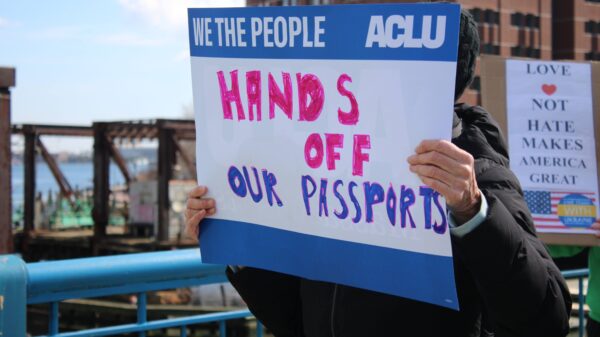
Orr v. Trump
We filed a federal lawsuit challenging an Executive Order requiring all new passports to display an individual's biological sex at birth.
Jul 29, 2026
ACLU of Massachusetts v. U.S. Department of Defense
We sued the U.S. Department of Defense for public records on military officers assigned to serve as temporary immigration judges. The apparent deployment of active-duty military personnel as judges with the power to deport and jail civilians raises serious constitutional questions.
Jun 22, 2026
Zapata Rivera v. Jackson
In December 2025, the ACLU of Massachusetts filed a federal lawsuit on behalf of our client, Carlos Zapata Rivera. The lawsuit alleges that an ICE agent unlawfully applied a carotid restraint to Mr. Zapata Rivera while arresting him on Nov. 6, 2025, then refused him prompt emergency medical care.
Mr. Zapata Rivera, a resident of Fitchburg, Massachusetts, was driving his wife to work with their one-year-old daughter in the car when they were pulled over by several ICE agents. The agents informed Mr. Zapata Rivera’s wife that they intended to arrest her. The lawsuit alleges that David Jackson, a federal agent employed by ICE, climbed into the vehicle and pressed his thumbs forcefully on Mr. Zapata Rivera’s carotid arteries, restricting blood flow to his brain. Mr. Zapata Rivera lost consciousness, and he experienced involuntary seizure-like movements. Jackson continued to apply the carotid restraint with at least one hand while these involuntary movements continued.
The Department of Homeland Security’s own policies prohibit agents from using carotid restraint techniques except when deadly force is justified.
The lawsuit also alleges that ICE agents refused to allow Mr. Zapata Rivera to be evaluated by emergency medical personnel at the scene. After his release, he continued to suffer severe physical symptoms and went to the emergency room for treatment.
The Department of Homeland Security’s public statements about the incident accused Mr. Zapata Rivera of faking a seizure and refusing medical care.
An immigrant from Ecuador, Mr. Zapata Rivera applied for asylum in early 2024 and has been authorized to work in the United States while that application is pending. After his counsel sent a letter to ICE requesting that the agency preserve evidence relating to this incident, ICE abruptly sent Mr. Zapata Rivera a “call-in letter” demanding that he appear with his passport at ICE’s Burlington office at 10 a.m. on Thursday, Dec. 18, 2025. It was the first time he had received such a request since early 2023.


Stay Informed
Sign up to be the first to hear about how to take action.
By completing this form, I agree to receive occasional emails per the terms of the ACLU’s privacy statement.
By completing this form, I agree to receive occasional emails per the terms of the ACLU’s privacy statement.