More than 40 cities across Massachusetts have cut ties with Flock. On November 17, the state’s third-biggest city may join the list, as the Springfield City Council is set to discuss proposed legislation that would bar the use of Flock’s license plate reader technology.
To inform the public debate, the ACLU of Massachusetts is publishing information we received from the Springfield Police Department (SPD) in response to a September 2026 public records request.
The ACLU of Massachusetts has reviewed millions of data points from audit logs showing who has accessed Flock data from Springfield and for what reasons from January 2024 to early October 2026. These data show:
- Federal agencies searched Springfield’s Flock data directly. Agencies searching included Homeland Security Investigations (HSI), which is part of ICE, and U.S. Border Patrol.
- Police nationwide cited “immigration” or federal agencies that enforce immigration — ICE, HSI, Customs and Border Protection, Border Patrol — as their reasons for nearly 1,500 searches of Springfield’s data between January 2024 and August 2026.
- Police have used Flock to search for people, not just cars, in searches that have queried data from Springfield’s cameras.
- Springfield police officers have searched Springfield’s Flock data in connection with protests and political rallies, as have other police working for departments in other communities.
Before they vote on the proposed ordinance, it’s critical that elected officials in Springfield understand how Flock data collected in Springfield has been used by the SPD and police in other parts of the country.
Nationwide data sharing opened the door to millions of searches — including for immigration and protest surveillance
For years, until early 2026, the Springfield Police Department allowed police across the United States to search data showing where and when Springfield residents and visitors drove. Between January 2024 and early December 2025, agencies outside of Springfield searched Springfield’s Flock data more than 9 million times, mining information collected by Springfield’s dozens of Flock cameras.
Police in Texas searched Springfield’s Flock data more than 1.8 million times. Police in Florida, where state law requires local law enforcement to take part in civil immigration enforcement, searched the records more than 600,000 times.
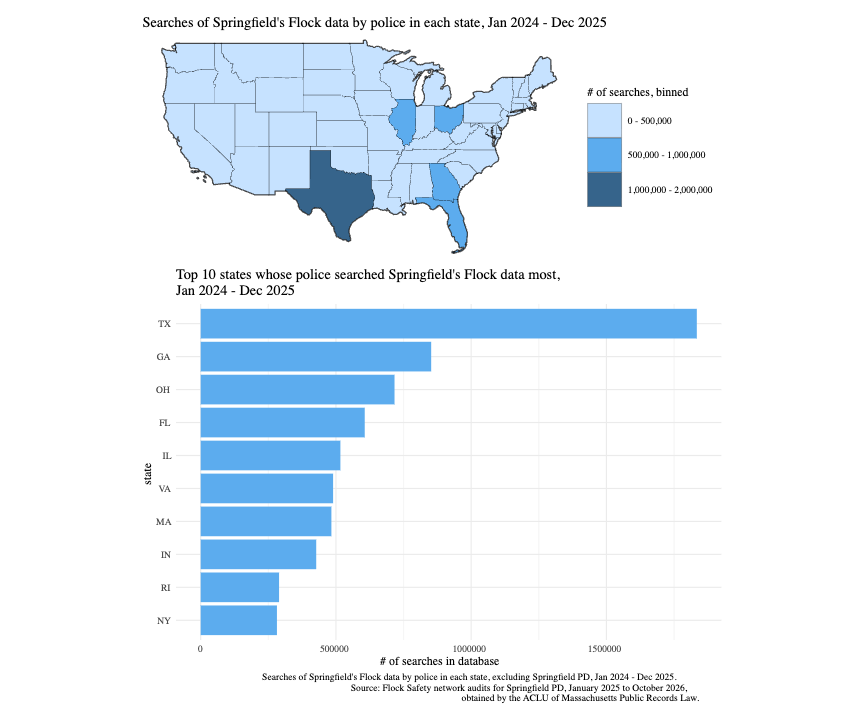
Most of these were nationwide lookups: single searches that ran across thousands of Flock networks at once, including Springfield’s. Those nationwide lookups stopped around February 2026. MassLive reported that SPD began limiting access to its data to agencies in Massachusetts and surrounding states earlier this year, and indeed, since February, most of the searches have come from New England and New York.
But that change came from settings that Springfield PD and Flock control, not from any law, and it can be reversed at any time.
Thousands of searches related to immigration enforcement
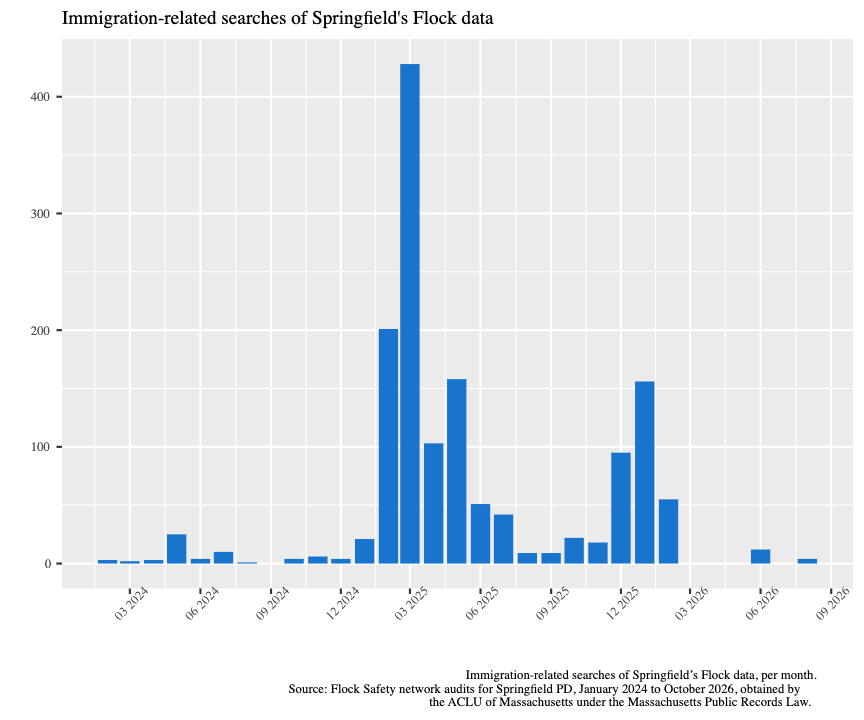
Between January 2024 and August 2026, police searched Springfield’s Flock data nearly 1,500 times for reasons citing Customs and Border Protection, Border Patrol, HSI, or “immigration.”
The most recent search explicitly naming ICE’s deportation operations was conducted on July 10, 2026, at 7:39 a.m. by an officer with the Barnstable Police Department. In the reason field, the officer wrote “Wanted Person (Arrest Warrant/Fugitive) – warrants/ERO.” ERO stands for Enforcement and Removal Operations, ICE’s deportation arm. ERO uses civil administrative “warrants,” signed by immigration officers rather than judges, in its deportation process. It wasn’t the first time that Springfield’s data had been searched to support ICE’s deportation agenda: on November 2, 2025, Barnstable police ran five searches with the reason “Ero.”
More recently, in August 2026, the Marlborough Police Department cited HSI as the reason for searching Springfield’s Flock data. HSI is part of ICE, and since January 20, 2025, HSI has been directed to devote resources to civil immigration enforcement alongside ERO. (Even prior to the second Trump administration, advocacy groups were raising the alarm about HSI’s involvement in deportation operations.)
Immigration-related searches of Springfield’s Flock data peaked in March 2025, with 428 searches. They continued into 2026: although searches naming immigration-related keywords declined sharply after February 2026, HSI-related searches continued through the summer.
Federal agencies searched Springfield’s data directly
Flock’s audit logs label some accounts as federal agencies, and public records show that they routinely searched Springfield’s cameras.
For example, in 2025,
- A Homeland Security Investigations account ran 172 searches between March and May of 2025;
- U.S. Border Patrol accounts ran 201 searches in May and June; and
- The Naval Criminal Investigative Service ran 123 searches throughout the year.
The data indicate that federal agencies are now inactive and unable to search through Springfield’s Flock database. However, that has not stopped local law enforcement from conducting searches in collaboration with these agencies. In 2026, there were 243 searches, mainly from New England and New York, that referenced HSI.
Meanwhile, the U.S. Postal Inspection Service—the USPS federal police force—has searched Springfield’s data more than 70,000 times since 2024, and those searches continued through early October 2026. This is especially alarming in light of recent reporting revealing how the USPS police force has tracked political activists, including by using Clearview AI’s facial recognition and monitoring speech on social media platforms.
Police searched Springfield’s Flock data in connection with protests
Immigration isn’t the only reason Springfield residents should be concerned about Flock and license plate readers. The records also show that police nationwide, and in Springfield, used Flock data to look for information about people engaged in First Amendment–protected activity.
Between January 2024 and early October 2026, police nationwide searched Springfield’s Flock data more than 180 times in connection with protests or political rallies. The reasons officers gave included “suspicious protester vehicle ‘no kings,’” “protest activity,” “protest rally,” “protest intelligence” and “Trump rally POI [person of interest].” In a single day, July 4, 2025, the Lubbock, Texas police department ran 54 searches labeled “protest [].”
Springfield police officers did it, too. On February 19, 2024, SPD Officer Haley Radisic ran six searches on two license plates. The reason Officer Radisic gave for the search: “Palestinian Protest 02-19-2024.” On October 13, 2024, Officer Olivia Malone ran two searches of one license plate, writing “protest” as the reason.
Flock captures and allows for searches of people — not just cars
Flock’s system lets officers search footage with plain-language descriptions, including descriptions of people.
On April 8, 2026, police in Providence, R.I. ran one such search that reached Springfield’s data. It was labeled “[people] lime green hoodie and green checkered pajama pants pushing scooter.” Police in Braintree, MA, Nashua, NH, and Norwalk, CT ran similar people-related searches between October 2025 and June 2026.
It’s not just Flock: Springfield’s use of Motorola’s Vigilant system raises the same concerns
The records obtained from Springfield PD also include audits of the department’s searches of license plate reader data held by Flock’s main competitor, Motorola Solutions, through its Vigilant system.
Like Flock, Vigilant offers police a nationwide database, including billions of license plate location records collected by private companies. Unlike Flock, which says ICE is not among its direct government customers, Vigilant has contracted directly with ICE, including ERO. That relationship shows up in Springfield’s Vigilant records: between February and October 2026, SPD officers ran eight searches that drew on license plate data shared by ICE ERO.
SPD did not provide records showing how outside agencies searched its own Vigilant data. City councilors and residents concerned about SPD’s license plate surveillance should request those records to learn whether SPD shares its data directly with ICE’s deportation officers.
The problem is likely much worse than the audits show
The records analyzed here confirm that police continued to search Springfield’s Flock data for immigration-related reasons well into 2026. They confirm police used Flock for protest monitoring. And they confirm Springfield police have multiple license plate surveillance programs in effect, including with a company that directly contracts with the deportation arm of ICE — significantly expanding the threat of misuse and abuse.
But even these records likely do not capture the full scale of the problem.
That’s because an officer aware of the backlash against license plate readers can conduct an immigration-related search and document it as something else, like “drugs” or “traffic infraction.” There is no system in place, technical or bureaucratic, to make sure officers tell the truth in the reason field when conducting a search. And the sheer number of searches makes effective oversight impossible.
Massachusetts residents learned this the hard way, after a series of scandals in which local police officers were accused of misusing Flock to track former romantic partners. In each case, officers documented their searches with innocuous-sounding reasons like “traffic,” which, according to police leadership, masked the real reasons for the searches.
Despite promises of reform and tweaks from police and Flock, this fundamental problem remains unaddressed, and with searches at this scale it is un-addressable. How could Flock or a police department ensure that the hundreds of thousands or even millions of searches run through the system every month are legitimate or follow policy? They can’t. There are simply too many.
But there is something we can do to address the scourge of mass surveillance targeting Massachusetts drivers today.
Springfield and other police departments in Massachusetts should stop using license plate readers until state law regulates them
SPD’s records reveal a license plate reader program that raises serious constitutional concerns for privacy and free speech. Left to their own devices, police allowed law enforcement nationwide, including federal agencies, to search information collected about Springfield residents, with almost no restrictions until early 2026 and no effective oversight.
In short, Springfield’s license plate reader program shows why Massachusetts urgently needs state regulations to protect residents’ fundamental privacy rights.
Thankfully, the Springfield City Council has filed legislation to block the use of Flock cameras. Lawmakers who seek to protect privacy and constitutional rights should be sure to block the use of all license plate readers, not just Flock’s.
Springfield should join communities across the state in prohibiting its police department from using this dragnet surveillance technology until state lawmakers put checks and balances in place statewide. No one should have to fear that just by driving down the street, they expose themselves and their families to warrantless government surveillance from their local department — let alone from police in other cities and states.
Privacy can’t protect itself, but you can join the ACLU’s fight to ensure police cannot use technology like Flock to violate our most cherished rights and liberties. Take action today by emailing the Springfield City Council and the Mayor’s office, then help us spread the word.
To see the data, visit the ACLU of Massachusetts Github.