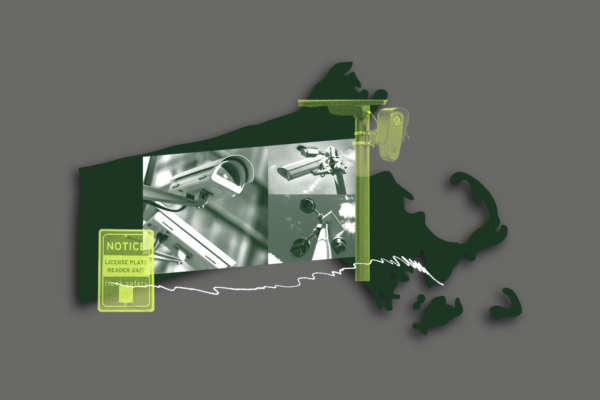
In October 2025, the ACLU of Massachusetts launched a campaign to raise awareness about the widespread use of license plate readers (LPRs) by police. Sold by companies like Flock Safety, these cameras allow police to track any driver who passes by — without a warrant and regardless of whether there is a reasonable suspicion of wrongdoing.
This dragnet surveillance has raised alarm throughout the Commonwealth and across party lines, inspiring local activists to write to their city councilors and show up to town meetings to voice concern. As a result of this advocacy, many select boards and police departments have opted to cut ties with LPR companies.
In recent months, this grassroots movement has exploded. So far, over 40 Massachusetts communities have said Get the Flock Out! Sharon is one of them.
We reached out to Sharon activists Alyssa Aftosmes-Tobio and Ed Connelly to learn how they are thinking about grassroots advocacy and the fight to stop LPRs and other unwanted police tech from surveilling Massachusetts communities.
Below is the conversation, edited for clarity.
Clearly, the presence of LPRs in Sharon had a strong impact on you. What was the tipping point that made you decide it was time to take action to fight Flock’s deployment in your town?
Alyssa: I jumped into action as soon as I realized that I’d passed a Flock LPR camera in Sharon. I was honestly completely confused as to why they would be used here. I had been reading about Flock for a while and was concerned about coordination with ICE, particularly with private companies like Home Depot.
I was also increasingly concerned with the amount of data we collectively hand over to third party companies, how much control they have over that data, and what they could possibly do with it in the future.
From there, I started collecting information about their installation and talking with my community networks about the issue. Most people, myself included, were alarmed to find out that there was no process to approve the installation of Flock LPRs; our Select Board voted for the private donations that paid for the system, but later several members admitted they did not know what the donations were going to be used for.
Given the vast amounts of data being funneled into Flock’s networks each day, this was a massive oversight and deserves our attention and scrutiny.
Ed: The Town of Sharon’s actions in contracting with Flock without any public process infuriated me. I felt the use of this technology was completely unnecessary, a great threat to personal liberty, and a place where we could take action as citizens against the ever- growing threats of a surveillance state.
What concerns you the most about AI-powered LPR cameras?
Alyssa: There is very little that doesn’t concern me. I am most alarmed by the interconnected systems that the cameras feed data into, coupled with the lack of legal guardrails to protect folks just going about their lives with no interaction with law enforcement.
Taken in the larger context of an executive branch quite willing to bend the law until it breaks, unfettered deployment of surveillance technology should alarm us all.
Ed: I object to a surveillance state and believe that Flock-type devices are a threat to constitutionally guaranteed rights and civil liberties. The ability to track my comings and goings without probable cause that I have committed a crime is anathema to our guarantees of personal freedom.
How did you think about privacy rights before you learned about Flock? Had you ever advocated on an issue like this before?
Alyssa: Most of my concern or consideration for data and privacy came after my oldest child was born. We were committed to not sharing photos of him online, so I was reading the fine print of pretty much any app or service we wanted to use in relation to him. This led me to read Terms of Service as a standard practice. So really, I conceptualized privacy rights as an individual issue, and something that I had to take upon myself to ensure. This is my first time advocating for an issue like this.
Ed: I had not advocated like this before. The erosion of privacy has been a concern for many years, but since most actions compromising privacy are being done by private parties, it was difficult to determine what to do. It seems hopeless to lobby for national laws protecting privacy.
The actions of our town crossed a line because it was a government actor surveilling us, and we had more of an ability to object to and seek changes in local policy.
The ACLU of Massachusetts has created a Community Advocacy Toolkit to help Bay Staters speak out about their privacy concerns during town halls and online. To help beginners get started with advocacy, what was the first step you took to fight unwelcome community surveillance by police?
Alyssa and Ed: Our first step was to reach out to people we knew — friends, neighbors, community activists — and let them know what we had discovered about the installation of Flock cameras and the use of private donations to do it.
Collectively, we wrote to the Select Board to communicate our disagreement with the lack of public input and the installation as a whole. After additional back and forth, those who had written in were invited to meet with representatives from the town: two members of the Select Board, the Town Administrator, and our Police Chief.
Much to our surprise, the meeting was also attended by a representative from Flock and multiple police detectives. Town representatives made their position clear, while we left with our concerns intact and many questions still unanswered.
Sharon’s Select Board voted to not renew the town’s existing Flock contract once it expired in Sept. 2026. How did you get the Select Board to listen to your concerns? Which of your points do you think they were most receptive to?
Alyssa and Ed: After discussing the issue with a small group of Sharon residents, we decided to use the open town meeting structure, and our ability to call for a special town meeting, to pressure the town to remove the cameras.
We first wrote a letter to the Select Board expressing our concerns, arguing that the Board’s decision to install Flock cameras — and their failure to change their decision — was far outside the traditional way important town decisions had been made in the past. We also noted that the Board acted hastily and we requested that they reverse their course of action.
We made it clear that we would not accept keeping the cameras in town and stated that we would seek a special town meeting vote to remove the cameras and take up a surveillance bylaw if the Board did not act.
The Select Board invited our group to debate the issue at a scheduled meeting, which we declined. Instead, we met privately with the Town Administrator and informed him of our plans to call a special town meeting if the contract remained in place.
Beyond fighting against dragnet LPR surveillance, the ACLU is strongly advocating for Community Control Over Police Surveillance (CCOPS). CCOPS requires police departments to get community buy-in before acquiring new surveillance tech. How has your advocacy work affected the town’s relationship with the police department?
Alyssa and Ed: By and large, our community members are supportive of our police department. We have an amazing police sergeant who attends many, many community events and engages with families regularly. That type of community policing does not go unnoticed and is critical for public safety.
Also, the police chief was receptive to our concerns, which helped ensure a cooperative relationship.
As we told our town representatives, we went back over more than a decade of crime data for Sharon. We found an exceedingly low crime rate, which we readily credited to their abilities as a department.
At the time of writing this, we are still in discussions with the town about our drafted surveillance bylaw, which we hope will pass at our Annual Town Meeting in the spring of 2027. We hope that will demonstrate the community’s desire to be informed about policing in our town and to be engaged in the process.
What’s next for your advocacy work in Sharon?
Alyssa: I am focused on getting our surveillance technology bylaw on the warrant for our spring 2027 Town Meeting. When it is adopted, it will require ongoing vigilance around our Select Board discussing requests for approval, and the proper implementation of the bylaw.
I am also part of the Sharon Digital Wellness Alliance, which is a grassroots community group focused on ensuring that technology is used in our school systems in a balanced way.
Ed: I would like to work with other towns to help with their efforts. I would also like to meet with our state representative and senator to advocate for statewide laws to address surveillance issues.
Reach out!
You can contact Alyssa and Ed with questions about how to fight excessive government surveillance in your city or town at sharontechbylaw@gmail.com
Become an advocate
To build your skills as a community advocate, check out webinars and other resources from our Advocates Academy