
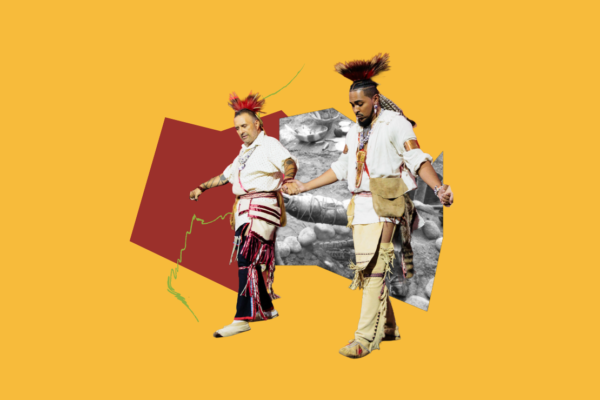
In the leadup to Thanksgiving and the National Day of Mourning, Racial Justice Community Advocate Cole Gibson sat down with Hartman Deetz, an enrolled member of the Mashpee Wampanoag tribe, to discuss his activism and the importance of reciprocity.
Hartman is a Native activist and artist based in Massachusetts. His tribe, the Mashpee Wampanoag, are the people of Cape Cod and the Upper Cape, geographically located on Mashpee Pond and the Mashpee River. They are on the forefront of speaking, acting, and advocating for Indigenous rights on the eastern seaboard.
Below is Cole’s conversation with Hartman, edited for clarity and brevity.
Cole: You are a craftsman of Wampanoag arts, a pow wow dancer, and an activist — among other things. How has your cultural history guided your work?
Hartman: As someone who wants to emulate the image of my ancestors and their teachings, it pretty heavily guided my work. I see it as my responsibility to care for and advocate for the lands that have been part of our placement since time immemorial. This care includes other relatives and neighbors sharing this land: the deer, the heron, the hawks, the oak trees, the sassafras.
In my art and practice, I do traditional arts and contemporary arts. I want to emulate the way my ancestors made things and how they chose to decorate and adorn things.
Cole: I hear a call to remembrance and stewardship when talking about your work and the meaning behind it. How do you see that connecting to the fight for racial justice more broadly?
Hartman: As Native people, we are taught to advocate for all our neighbors, even the trees and plants. To see them as our relatives and our equals. If we can look at the oak tree and see it as our brethren, and advocate for the needs of the oak tree, how can we not see another human being as our relative, as our brother, and as our equal?
We all deserve a baseline of human dignity and respect as living free beings in this world, created by a Creator, with just as much purpose as anyone or anything else.
When we see people treated in ways that degrade their humanity or oppress them, we are also responsible to speak out against that. That treatment doesn’t make for a good world to live in for any of us.
Cole: For many — especially Indigenous people and people of color — the upcoming Thanksgiving holiday, which is supposed to be a time of thanks and reflection, can feel like anything but. What do you feel at this time of year?
Hartman: The first holiday where we joined and ate food together, the first Thanksgiving, was declared after a military victory over the Pequot. After a massacre where colonizers killed women and children and elders. Burned people alive in their villages and their homes. This was Thanksgiving to them.
But to us, we had 13 thanksgivings a year. Each cycle of the moon had some gift that the world gave in abundance, and we were supposed to be thankful and appreciative of those things so that we could survive.
For colonizers, it was to be thankful for the extermination of their brothers, of fellow human beings, so that they could exalt themselves above other peoples. To continue to celebrate that is almost appropriate, considering how America continues to carry itself as if it’s above the rest of the world. As if American citizens’ needs and dreams and wants are above those of any place else in the world — particularly those of white Americans. That seems to be the status quo, and one that there’s a concerted effort to maintain, along with the myths and the narratives that are used to uphold it.
Cole: What do you think it would it look like for this country to truly and fully embody the intention behind the Thanksgiving holiday?
Hartman: We have 13 thanksgivings a year. So, be thankful for the abundance that the world gives you. Realize there is enough for all of us. That’s a powerful thing.
There is so much that the world gives people — to our neighbors, the animals, the trees. You don’t need to step on anybody else to be able to lift yourself up. There’s enough for us all if we take care of it. But there is not enough for this world to satisfy insatiable greed, the greed to have everything and more than anyone else. There will never be an abundance rich enough to satisfy that greed.
As long as we continue to teach greed or selfishness as values, we’ll never be able to satiate that appetite for continued exploitation of the natural world and of each other: our bodies, our souls, our minds.
We see this drive for Artificial Intelligence, the need to extract all of the written words and thinking of humanity. For what? And the continued exploitation and extraction of oil that is being burned and destroying our atmosphere and destroying our ability to live on this planet.
—If we stop to take care of what we have, there’s enough for everybody.
Hartman Deetz
We need to stop that hunger and the greed to have more more more and be thankful that we have enough. And that’s really a big shift in the mindset of America in particular.
Cole: Can we dive a little deeper into the concept of reciprocity?
Hartman: There is a need to continue investing in things that care for us.
When we garden, we don’t just consume all the fruit of the garden — we save some seeds to plant next year. It’s not enough to just water the garden and eat the fruit. You need to save something and plant again next year because you can’t keep taking forever. It just doesn’t work.
This outlook needs to spread beyond seeds and soil to how we look at the world in general. How do we invest in those things that care for us so they can continue to care for us?
We saw this issue in Florida, which has some of the harshest immigration policies. The immigrant labor that left the state due to these policies was a really hard blow. Florida’s ability to farm oranges suffered, building development came to a standstill, and the many elderly folks in nursing homes who depend on immigrants to care for them suffered. Cost of living skyrocketed. Because that investment wasn’t put into the people providing care. This is another way of showing insatiable greed just doesn’t work in the long run.
When you leave people with nothing and no ability to tend and care for their own needs, which is where we’re at — people can’t afford a home, or food on the table, or clothes on their back, yet they are working 40-plus hours a week or more — this is unsustainable.
Cole: The Mashpee Wampanoag’s sovereignty and rights have been threatened by colonial powers, the Massachusetts government, and mainstream society for centuries. With this complicated history in mind, what do you think a better tomorrow looks like?
Hartman: I have little faith in the political establishment of the U.S. I don’t have much hope for the establishment as it exists to create solutions for us. But hopefully people can recognize the inherent power we have in ourselves. To create a new way forward that works for the needs of the people.
We need to be able to have clean air, soil, water. It is fundamental for the continuance of life on Earth. At this point, we can’t even count on rainwater, which is polluted in forever chemicals. It is ridiculous to have to say it, and I have to say it so often. Most people would be happy to trade a little bit of convenience for some guarantees that we have a world to live in.
We also need to look at our educational system — both what we teach as our values and how we teach. There is so much that children can learn if we encourage their curiosity instead of trying to kill it. That would be a huge thing.
—We don’t need more surveillance to ensure that we’re conforming. We need more freedom to be able to explore different ideas and new ways of thinking outside of the realm of the minds that created these problems. We need to start rewarding a mindset that helps us all.
Hartman Deetz
Cole: What can allies do to help further the advocacy efforts of the Mashpee Wampanoag and the Wampanoag nation, and Indigenous peoples everywhere impacted by colonialism?
Hartman: I was taught the idea of “if you see a need, fill a need.” Take it upon yourself to do it. All of us see big problems, and we’re waiting on others to tell us the solution.
The Wampanoag people need to be treated with dignity. If we had that, we’d be fine. If you see that we’re being treated in a way that others wouldn’t want to be treated, advocate for us. Ask why we’re being treated differently.
We want our land rights heard, to be held to the same rule of law and economics, to be able to decide our own fate and sustain our people. Right now in Plymouth, we are advocating against gravel mining, and we need others to speak up too.
We need to invest in seeds, plant them, and see if they grow fruit. We can’t expect results if we don’t invest in them.