
By Traci Griffith
As the 250th anniversary of our nation’s founding approaches, I’m steeling myself for the deluge of patriotic signs and symbols that will, inevitably, wash over us all in that familiar visual language of red, white, and blue.
It’s human nature to seek out and create narratives to help us understand the world. What’s important is that we get to decide what those words and symbols mean to us.
What freedom means
Consider for a moment the word freedom.
Freedom is an ethos that politicians and everyday people alike use as a kind of shorthand to define what, exactly, makes this nation so great. And who doesn’t like the sound of freedom?
When many Americans hear the word freedom, they may envision a specific set of images: a striped flag blowing in the wind, a bald eagle soaring against a blue sky, buckle-shoed settlers debarking a wooden ship, the founding fathers writing the Declaration of Independence with its self-evident truths that all men are created equal.
But for many, myself included, freedom carries a very different meaning.
On July 4, 1776, roughly 500,000 enslaved people were living in the newly independent United States. The Declaration’s language of liberty and equality did not include them, and it was never meant to. The freedom celebrated in the nation’s founding was selective. It was shaped by a legal and philosophical vision that proclaimed liberty with one hand while enforcing bondage with the other. For hundreds of thousands of people, the founding promises of the United States were not guarantees, but exclusions.
For many, freedom came much later. In a lot of ways, it is still coming.
The question of monuments
You may be familiar with President Trump’s executive order to “beautify” our national parks and monuments in the leadup to America 250 (and likely afterwards) by sanitizing parks’ educational narratives so that they glorify, without exception, the American past.
In keeping with this order, the National Park Service recently instructed the stewards of Bunker Hill Monument in Charlestown to remove several historical quotes from its educational plaques.
The Bunker Hill Monument is a familiar symbol of revolutionary bravery here in Massachusetts. The monument’s disputed quotes came from people who had valuable perspectives to share. One was a quote explaining the unsung yet crucial role immigrants played in the American Revolution. Another quote was by military veterans critiquing the prevalence of American monuments that edify bloodshed. And another named the sad irony of a monument that is both a renowned symbol of freedom and also one honoring pro-slavery revolutionaries.
If these historical quotes and the Bunker Hill monument together are not representative of our American story, and if they are not all full-throated, even beautiful expressions of patriotism, I don’t know what is!
What I do know is that the way the American public is increasingly being asked to accept sanitized, jingoized symbols of American exceptionalism is dangerous.
Watching the ships come in
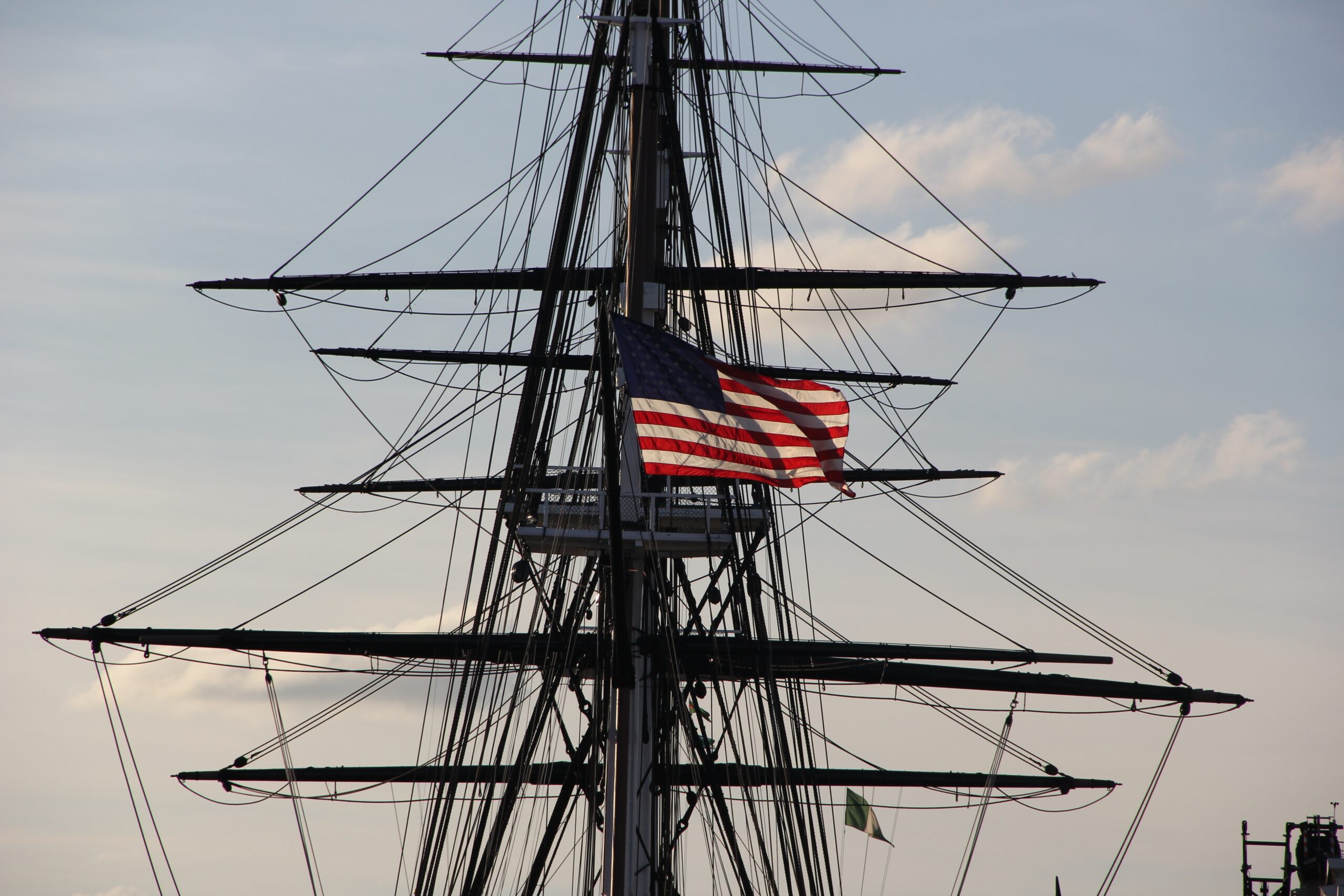
Image by Mary Bettini Blank from Pixabay
As our nation’s anniversary approaches, I’m also thinking about white sails.
Every year, the International Parade of Tall Ships journeys up the coast. This summer, the vessels will make port in Boston Harbor as part of the 250th festivities.
It would be dishonest to deny the spectacle of these historic ships. There is beauty in their scale, in the web of their rigging, in the elegance of wind filling their sails as they enter the harbor. As symbols, they call to mind international adventure and maritime prowess.
But admiration can interrupt reckoning.
When I see these ships drop anchor along our coast each year, I don’t think of the maritime pageantry alone.
When I see vast sails on the horizon, I think of ancestors. And no, not the buckle-shoed pilgrim kind. I think of people forced onto international tall ships — kidnapped from Africa and dragged into a new world shaped by terror, dispossession, and loss. And I think of colonizers arriving to these shores, a death knell for Native Americans for whom this 250th anniversary likely contains more grief than celebration.
Today’s ships are not those ships. But a symbol works powerful magic on the psyche. And what you see really depends on where you stand.
Some spectators will only observe the ships’ majesty and the skill of their crews. Some will experience an entirely different, entirely American story.
For myself, I see the Mayflower and the Middle Passage, colonial ambition and human suffering, freedom and oppression.
When July 4 hits, let’s not repeat an all too familiar harm: honoring just one national story. A meaningful commemoration requires us all to look closer.
Traci Griffith is the director of racial justice programs at the ACLU